
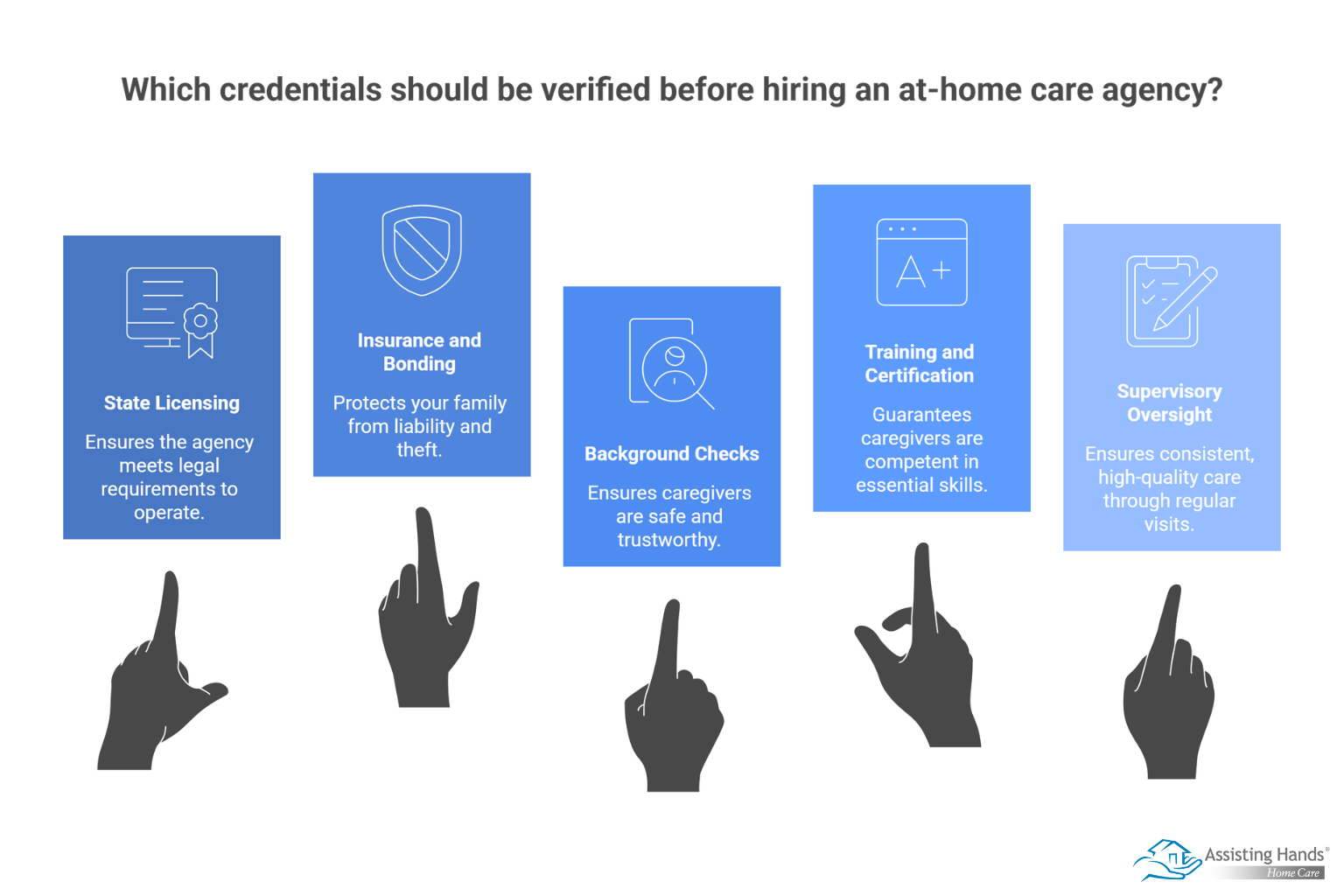
Verifying an in-home care agency’s credentials requires confirming five core elements: state licensing, liability and workers’ compensation insurance, comprehensive background checks on caregivers, staff training certifications, and supervisory oversight systems. Together, these credentials indicate whether an agency meets legal requirements, protects your family from liability, and consistently delivers safe, professional care.
Selecting a caregiver for an aging parent or relative is a decision laden with emotional weight and responsibility. To ensure safety and peace of mind, you must look beyond the sales pitch and rigorously verify the credentials of any potential provider.
Is the Agency Licensed and Accredited?
The first step in your evaluation is determining if the agency meets the baseline legal requirements to operate. Licensing requirements for nonmedical home care agencies vary significantly by state. Some states have strict regulations, while others have very few.
Ask the agency for proof of their state license and verify it with your state’s health department or department of social services. Beyond the basic license, look for voluntary accreditation. Agencies that have sought accreditation from third-party organizations, such as the Joint Commission or the Community Health Accreditation Partner (CHAP), have demonstrated a commitment to higher standards of care and operational excellence. These credentials indicate the agency subjects itself to regular rigorous audits.
Are They Fully Insured and Bonded?
One of the primary benefits of hiring an agency versus a private independent caregiver is the financial protection it offers your family. However, this protection is only valid if the agency carries the proper policies.
You should request copies of the agency’s insurance certificates to verify the following coverages:
- General liability insurance – This covers property damage or bodily injury that might occur while the caregiver is in your home.
- Workers’ compensation – This is critical. If a caregiver injures his or her back lifting your loved one or slips on your icy walkway, workers’ comp covers the caregiver’s medical bills. Without this, your family could be personally liable for those costs.
- Bonding – A fidelity bond specifically protects you against theft or property loss caused by an employee of the agency.
If you have a senior loved one who needs help maintaining a high quality of life while aging in place, reach out to Assisting Hands Home Care, a leading provider of elderly home care Frederick families can rely on. All of our caregivers are bonded, licensed, and insured, there are no hidden fees, and we never ask our clients to sign long-term contracts.
How Rigorous Is the Background Check Process?
A reputable agency conducts comprehensive background checks to ensure caregivers are safe, trustworthy, and qualified. Inviting a stranger into the privacy of a home requires immense trust, so you must know exactly how the agency screens its employees. A reputable agency handles the entire vetting process, saving you the trouble of running checks yourself.
Don’t settle for a simple “yes” when asking if they perform background checks. Ask for specifics regarding the scope of their screening:
- Criminal history – Does the check cover only the local county, or is it a state and federal search?
- Driving record – If the caregiver will be transporting your loved one to appointments, a clean motor vehicle record is essential.
- Drug screening – Ask if the agency conducts pre-employment drug testing and if they have a policy for random testing thereafter.
- Sex offender registry – Verify that checking the national sex offender registry is a standard part of their hiring protocol.
What Training and Certification Do Caregivers Receive?
Caregivers must complete orientation training and maintain certifications in essential care competencies. Credentials aren’t just about safety checks. They’re also about competency. The “warm body” approach to care—where anyone willing to work is hired—is dangerous. You need to evaluate how the agency ensures its staff is actually qualified to provide care.
Inquire about the initial orientation and ongoing education requirements. A high-quality agency will require staff to demonstrate competence in essential skills such as:
- Infection control and hygiene
- Safe transfer techniques (moving a client from bed to chair)
- Emergency protocols and CPR/first aid certification
- Specialized care for chronic conditions like Alzheimer’s, dementia, or Parkinson’s
Aging in place can present a few unique challenges for older adults. Some only require part-time assistance with exercise or meal preparation, while others are living with serious illnesses and benefit more significantly from receiving Frederick live-in care. Assisting Hands Home Care are leaders in the elderly in-home care industry for good reason. We tailor our care plans based on each senior’s individual needs, our caregivers continue to receive updated training in senior care as new developments arise, and we also offer comprehensive care for seniors with Alzheimer’s, dementia, and Parkinson’s.
How Is Care Monitored and Supervised?
The agency should conduct initial assessments, create personalized care plans, and perform regular supervisory visits. High-quality care isn’t a “set it and forget it” service. A credentialed agency distinguishes itself through active management and clinical oversight.
Determine who’s responsible for the caregiver’s performance. Ideally, a qualified care manager should conduct an initial assessment to create a personalized care plan. Furthermore, ask about their policy for ongoing supervision. Does a supervisor make unannounced visits to the home to observe the caregiver in action? Regular supervisory visits ensure the care plan is being followed and that the personality match between the caregiver and the client remains positive.
Frequently Asked Questions
Is state licensing mandatory for all home care agencies?
No. Licensing requirements vary by state, with some requiring licenses and others having minimal regulations for nonmedical home care.
Should I hire an agency without workers’ compensation insurance?
No. Without workers’ compensation, your family becomes personally liable if a caregiver is injured while working in your home.
Do background checks guarantee a caregiver is trustworthy?
No, but comprehensive criminal, drug, and registry screenings significantly reduce risk and demonstrate the agency’s commitment to safety.
How often should supervisors visit to observe caregivers?
High-quality agencies conduct regular unannounced visits, typically monthly at minimum, to ensure care plans are followed correctly.
Are caregivers required to have CPR certification?
Most reputable agencies require CPR and first aid certification as part of their training requirements for all caregiving staff.
Whether your elderly loved one needs part-time assistance with basic household chores or you need a break from your caregiving duties, the Frederick respite care experts at Assisting Hands Home Care are here to help. All of our home care services are backed with a 100% satisfaction guarantee, there are no hidden fees in our contracts, and we never ask our clients to sign long-term contracts. To learn more about our premier in-home care plans, call us today.